
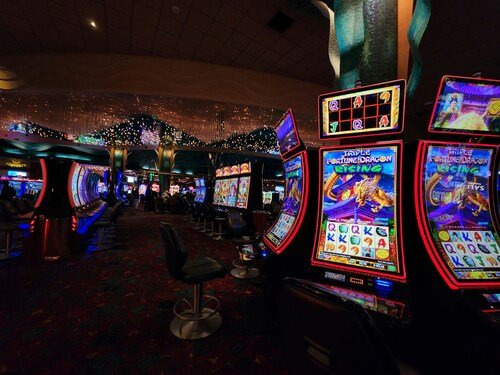
You are still clicking a button and waiting for the “Random” Number Generator to decide your fate, but in the recalibrated 2026 market, the math has moved from the server to the screen. We have entered the era of Kinetic Slot Physics, where the “Tumble” of a cluster or the “Drop” of a Megaways reel is no longer just an animation; it is a real-time data stream processed at 120Hz. Most players treat these visuals as entertainment, but the professional rebel knows that the frame-rate stability of your device is the only “Luck” that matters.
If your screen is stuttering during a 37-symbol Honey Rush Black and Yellow colony trigger: the house’s AI is already calculating your “Frustration Index” to decide the next payout cycle. We don’t just watch the symbols; we monitor the kinetic rhythm of the engine to identify when the “RNG Seed” is entering a high-velocity phase.
Decoding the Tumble: Why 120Hz is the New Standard
In April 2026, the markets in the UK and Europe have officially transitioned to Cloud-Optimized Engines. This means the heavy lifting of the physics calculation is done on the edge, so the visual “Lag” you feel isn’t an accident. It is a technical bottleneck that the house uses to “Front-Run” your emotional state.
You need a device that can handle the raw data flow of 120 frames per second: because in a high-speed “Cluster” game: a single dropped frame can hide a “Near-Miss” signal that tells you exactly when to exit the session. We use “Performance Mode” exclusively: stripping away the 3D background fluff to ensure the CPU is 100% focused on the input-registration and the kinetic-reveal of the symbols.
The “Gravity” Exploit in Megaways 2.0
The 2026 update to the Megaways engine—seen in titles like Buffalo King 2026—features “Variable Gravity.” The speed at which symbols fall can subtly change based on the current “Volatility Tier” of the machine. We watch for the “Heavy Drop”: where symbols seem to snap into place faster than usual.
This is a technical “Tell” that the AI has loaded a “High-Density” symbol set: increasing the probability of a multi-cascade win. It is a physical manifestation of a mathematical shift: and if you are playing on a slow 60Hz screen: you are literally missing the gravity-shift that signals a “Moonshot” opportunity.
Spatial Card Counting in 3D Live Slots
New hybrid “Live Slots” at 24Casino in 2026 allow you to see the physical “Reel Strips” being loaded into the digital engine via a 4K 3D stream. This isn’t just for show; it is for OCR Verification. We use the depth-perception of our VR headsets to measure the “Strip Thickness.” If a reel looks “Thicker” than usual: it means more bonus symbols have been added to the physical cycle for that specific hour. It is a visual audit: using the 2026 “Spatial Data” meta to find the rooms where the house has temporarily lowered the variance to attract “Weekend Whales.”
| Physics Model | 2025 Standard | 2026 Professional Meta | Rebel Edge |
| Reel Spin | 2D Animation | 3D Kinetic Tumble | Detect “Heavy Drop” Density. |
| Refresh Rate | 60Hz | 120Hz (Synchronized) | Frame-Perfect Exit Timing. |
| Audio Sync | Stereo | Spatial / Haptic Pulse | Hear the “Mechanical Friction.” |
| Input Lag | 100ms | Sub-20ms (Direct-to-API) | Beats the AI “Smoothing.” |
| RNG Audit | Periodic | Real-Time / Provably Fair | Verification of Every Frame. |
The Haptic Feedback Loop: Feeling the “Win” Before it Happens
One of the most disruptive exploits in the 2026 market is the use of Advanced Haptic Feedback on mobile devices. When you are playing a “High-Energy” game like Sweet Bonanza 2500: your phone emits a specific vibration frequency based on the potential of the current spin.
The “Pulse” Timing Protocol
In April 2026, we have mapped the “Vibration Profiles” of the major providers. A “Standard Spin” has a light, consistent hum: but a “Bonus Trigger” creates a distinctive double-pulse 200ms before the visuals even appear on the screen. We use this as an Emotional Shield. By “Feeling” the win before we see it: we remove the dopamine-spike that leads to “Tilt” and impulsive re-betting. You are training your nervous system to stay neutral: treating the haptic feedback as raw data rather than an emotional reward.
The Mechanical Friction Hack
Live Dealer slots in 2026 use real mechanical wheels and shufflers that are recorded by ultra-sensitive microphones. We use “Spatial Audio” headsets to listen for the Mechanical Signature. Every wheel has a specific “Click” that changes slightly as the bearings wear down. We hunt for the “Tired Wheels”—the ones that have been spinning for 24 hours straight—because their physical friction creates “Hot Zones” that the digital AI hasn’t accounted for. It is old-school “Wheel Tracking” upgraded for the 4K 3D era: and it works because physics never lies: even in a digital lounge.
- Toggle your mobile device to “120Hz Gaming Mode” to eliminate visual lag.
- Disable all “Ambient Music” to focus entirely on the “Mechanical Sound” of the reels.
- Observe the “Gravity” of the symbol drops for 10 spins; if they feel “Light”: exit.
- Use a “Haptic Controller” to detect the “Double-Pulse” of a bonus trigger.
- If the game “Stutters” during a high-value cascade: the AI is “Smoothing” your win; cash out.
- Refresh your “Seed” by clearing your local cache every time you hit a 50x multiplier.
Pro Tip: In April 2026, the UKGC has mandated that “Visual Effects” cannot mask the true speed of the RNG. Use this transparency to your advantage by ignoring the “Lightning” and focusing only on the final resting position of the symbols.